
输出 0 或 1 表示正面或者负面的情绪)
标签:
Week 1 Quiz: Recurrent Neural Networks(第一周考试:循环神经网络)\1. Suppose your training examples are sentences (sequences of words). Which of the following refers to the jth word in the ith training example?( 假设你的训练样本是句子(单词序列),下 面哪个选项指的是第??个训练样本中的第??个词?)
【 】 $??^{(??)} $
【 】 \(??^{<??>(??) }\)
【 】 \(??^{(??)<??>}\)
【 】 \(??^{<??>(??)}\)
答案【★】 ??(??) (注:首先获取第??个训练样本(用括号暗示),然后到??列获取单词(用括尖括号暗示)。)
?
\2. Consider this RNN: This specific type of architecture is appropriate when: (看一下下面的这 个循环神经网络:不才面的条件中,满足上图中的网络布局的参数是)
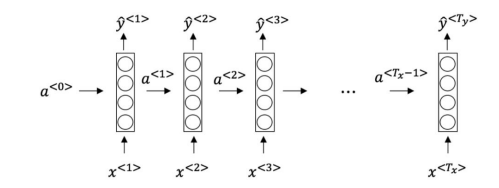
【 】$??_?? = ??_?? $
【 】 $??_?? < ??_?? $
【 】\(??_?? > ??_??\)
【 】$ ??_?? = 1 $
答案【★】???? = ????
?
\3. To which of these tasks would you apply a many-to-one RNN architecture? (Check all that apply). (上图中每一个输入都与输出相匹配。 这些任务中的哪一个会使用多对一的 RNN 体 系布局?)
【 】 Speech recognition (input an audio clip and output a transcript) (语音识别(输入语音, 输出文本)。)
【 】 Sentiment classification (input a piece of text and output a 0/1 to denote positive or negative sentiment) (感情分类(输入一段文字,输出 0 或 1 暗示正面或者负面的情绪)。)
【 】Image classification (input an image and output a label) (图像分类(输入一张图片,输出 对应的标签)。)
【 】 Gender recognition from speech (input an audio clip and output a label indicating the speaker’s gender) (人声性别识别(输入语音,输出措辞人的性别)。)
答案【★】 Sentiment classification (input a piece of text and output a 0/1 to denote positive or negative sentiment) (感情分类(输入一段文字,输出 0 或 1 暗示正面或者负面的情绪)。)
【★】 Gender recognition from speech (input an audio clip and output a label indicating the speaker’s gender) (人声性别识别(输入语音,,输出措辞人的性别)。)
?
\4. You are training this RNN language model.
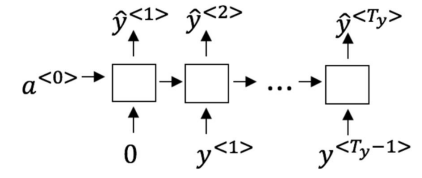
At the \(??^{th}\) time step, what is the RNN doing? Choose the best answer.( 假设你此刻正在训练下面 这个 RNN 的语言模型: 在??时,这个 RNN 在做什么?)
【 】 Estimating ??(\(??^{<1>}, ??^{<2>},… , ??^{<???1>}\))( 计算 ??(\(??^{<1>}, ??^{<2>},… , ??^{<???1>}\)) )
【 】 Estimating ??(\(??^{<??>}\)) (计算 ??(\(??^{<??>}\)) )
【 】Estimating \(??(?? ∣ ??^{<1>}, ??^{<2>},… , ??^{<??>})\) ( 计算 \(??(?? ∣ ??^{<1>}, ??^{<2>},… , ??^{<??>})\))
【 】Estimating \(??(?? ∣ ??^{<1>}, ??^{<2>}, … , ??^{<???1>})\)( 计算 \(??(?? ∣ ??^{<1>}, ??^{<2>}, … , ??^{<???1>})\))
答案Yes,in a language model we try to predict the next step based on the knowledge of all prior steps
【★】Estimating ??(?? ∣ ?? , ?? ,… , ?? ) ( 计算 ??(?? ∣ ?? , ?? , … , ??
温馨提示: 本文由Jm博客推荐,转载请保留链接: https://www.jmwww.net/file/web/30928.html


![[转]Node.js中package.json中^和~的区别](/uploads/allimg/200519/054J34453_lit.png "[转]Node.js中package.json中^和~的区别")